

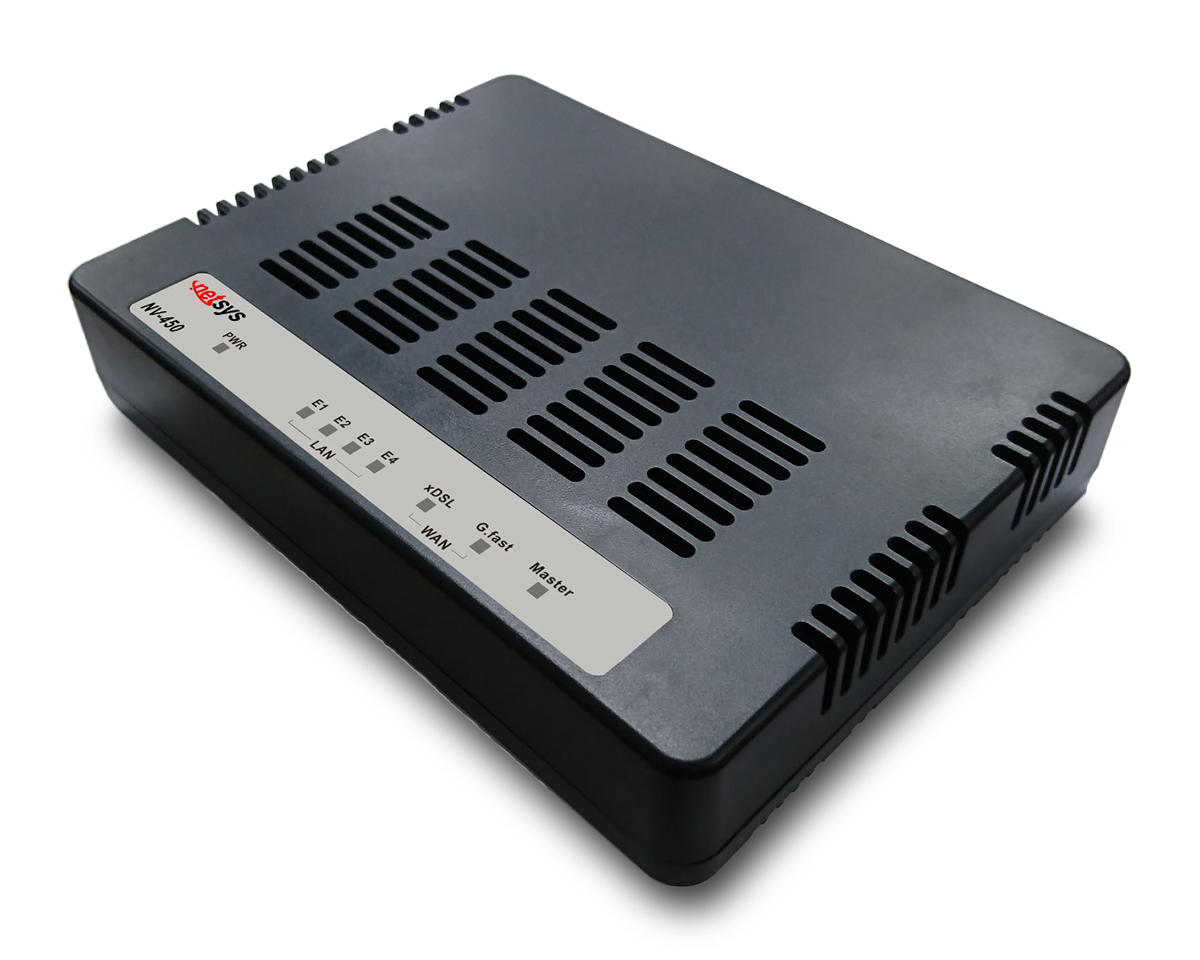
Curtains up for the NV-450 from Netsys, a bridge modem that supports the super-fast G.fast standard (ITU-T G.9700/9701). Thanks to G.fast, the NV-450 enables data transfer rates of up to 1 Gbit/s, e.g., via copper telephone cables. And that over a distance of up to 500 m.
G.fast is the successor standard to VDSL2. VDSL2 is limited to a data transfer speed of 100 Mbit and a distance of up to 300 m. With G.fast, the NV-450 is up to 10 times faster than a VDSL 2 converter – with almost twice the range.
The demand for higher data rates is constantly increasing, not least due to applications such as cloud computing, big data, and the Internet of Things. The high G-fast bandwidth of the NV-450 meets the requirements of these data-intensive applications.
The NV-450M/S is a cost-effective solution that utilizes existing copper wire infrastructure (telephone cables, two-wire lines). It consists of a pair of CO (NV-450M) and CPE (NV-450S) each with 4x 10/100/1000 Mbps RJ45 ports, 1x RJ11, 1x RJ11/terminal block combo port for POTS/ISDN.
Both models (M/S) not only support future-proof super vectoring compatibility (G.fast), but the NV-450S also supports VDSL2 and super vectoring (VDSL35b).
An integrated splitter, static routing function, management via HTTP, IPv6 support, firewall functions such as packet and URL filtering, DMZ, surge protection for the line port, and dual firmware image backup round out the functionality. A plug-in power supply is also included in the scope of delivery.
The NV-450 will be available from Avanis in August 2020.
Two wires – ready – go!
VDSL-technology is used wherever it is impossible or too costly to lay conventional twisted pair or fiber optic cables, but telephone cables are available. An existing telephone line (or similar two-wire line) is used for the simultaneous transmission of telephone and Ethernet (VDSL2 up to 100 Mbit, G.fast up to 1000 Mbit). This is made possible by connecting a converter at both ends of the line. The converter “mixes” telephone and Ethernet into a high-frequency signal, transmits it through the two-wire line, and separates it back into telephone and Ethernet at the end of the line.
In many private homes or commercial buildings, retrofitting conventional twisted pair or fiber optic cables is too expensive or impossible. VDSL / G.fast is the cost-effective and reliable alternative to rewiring.